
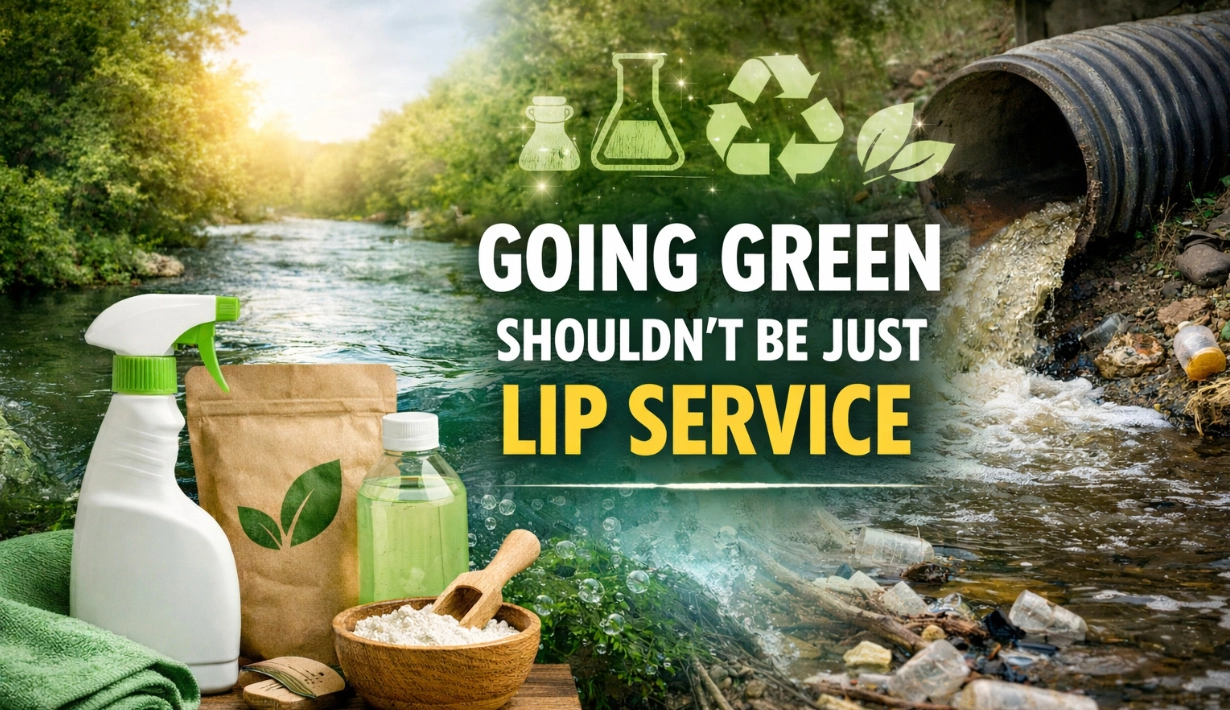
“Going green” is everywhere — on websites, labels, pitch decks, and product packaging. But customers have gotten very good at spotting the difference between real sustainability and green branding.
And in the cleaning industry, lip service isn’t harmless. What we rinse down drains and into municipal systems has knock-on effects for communities, infrastructure, and the environment. If “green” is only a slogan, the real costs still land somewhere — usually downstream.
At AfroECO, we believe going green should be practical, provable, and performance-driven. Here’s why it shouldn’t be just marketing — and what “real” looks like.
1) Vague “green” claims don’t build trust anymore
Words like eco-friendly, natural, clean, and non-toxic can sound good — but without specifics, they’re basically noise.
People want answers:
- What’s different about this product?
- What does it avoid?
- What impact does it reduce?
- Can the brand explain it clearly without buzzwords?
When brands can’t explain their sustainability in plain language, customers assume the worst — and trust drops fast.
2) Greenwashing hurts everyone (including the brands doing it right)
Greenwashing is when environmental claims are exaggerated, misleading, or impossible to verify. And it doesn’t just damage one brand — it makes customers suspicious of all sustainability messaging.
This is exactly why consumer protection and policy bodies are paying more attention to misleading green claims. If you want a solid example of what regulators are focusing on, the European Commission’s overview on green claims is a useful reference: EU guidance on green claims.
The direction is clear: claims need clarity, evidence, and transparency — not just aesthetics.
3) Real sustainability is operational, not aesthetic

A green logo, a leafy label, or a “planet-friendly” tagline doesn’t mean much if your operations haven’t changed.
Real sustainability shows up in decisions like:
- safer, more responsible formulations
- reduced harshness and unnecessary toxicity
- packaging choices that consider waste
- instructions that prevent overuse (because overuse = waste)
- measurable improvement over time
In other words: real sustainability has receipts.
If you want to understand AfroECO’s ethos and why we take this approach, our story is here: About AfroECO.
4) In South Africa, water impact isn’t optional
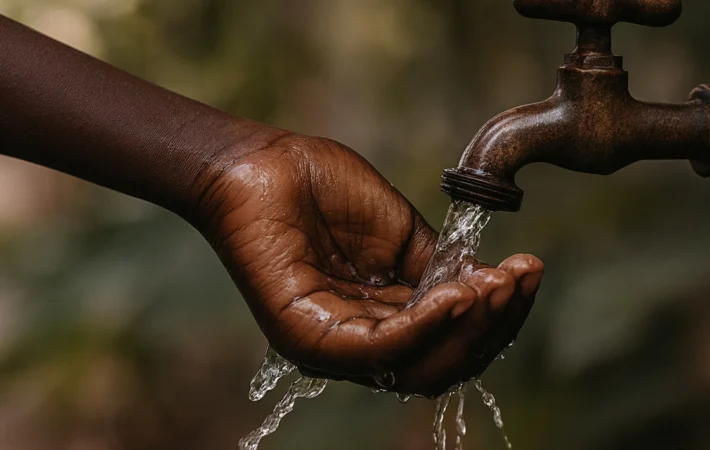
South Africa’s water reality makes sustainability more than a “nice-to-have.” What goes into drains moves into municipal systems — and when those systems are under pressure, pollution risk increases.
This is not theory — it’s an ongoing issue, and the Department of Water and Sanitation has highlighted concerns about pollution of rivers tied to municipal wastewater systems. Here’s the official reference: DWS statement on pollution of rivers and municipal treatment systems.
So when we talk about greener cleaning, it has to include the bigger picture:
- what happens after rinsing,
- what ends up in wastewater,
- and how product choices scale across households and industries.
Related reading if you want the deeper public-health angle: Unhygienic pit toilets and why sanitation matters.
5) “Going Green” should also mean “Safer for People”
Sustainability isn’t only about the planet. It’s also about the people who use cleaning products daily:
- at home
- in offices
- in workshops
- in industrial and sensitive environments
A product can’t be called responsible if it creates avoidable risk through harsh fumes, irritants, or unsafe handling expectations. A genuinely better approach is one that balances performance + safer everyday use.
6) Where enzymes fit: performance without the heavy-handed approach
This is where enzyme-based cleaning matters.
Enzymes don’t “mask” dirt — they help break down specific soils (like organic residues) so they can be lifted and rinsed more effectively. That can support a more responsible cleaning routine because:
- you may rely less on overly harsh actives for certain jobs,
- you can reduce waste caused by repeated “scrub and reapply” cycles,
- and you can clean effectively without turning cleaning into chemical warfare.
(And yes: performance matters. If an “eco” product doesn’t work, people use more of it — which is the opposite of sustainable.)
The bottom line
Going green shouldn’t be just lip service — because customers can tell, and the consequences of empty claims are real.
Sustainability should show up in how products are made, how they perform, how they’re explained, and how they affect people and water systems over time.
If your brand is going to say “green,” it needs to mean something.
Ready to clean greener without sacrificing performance?
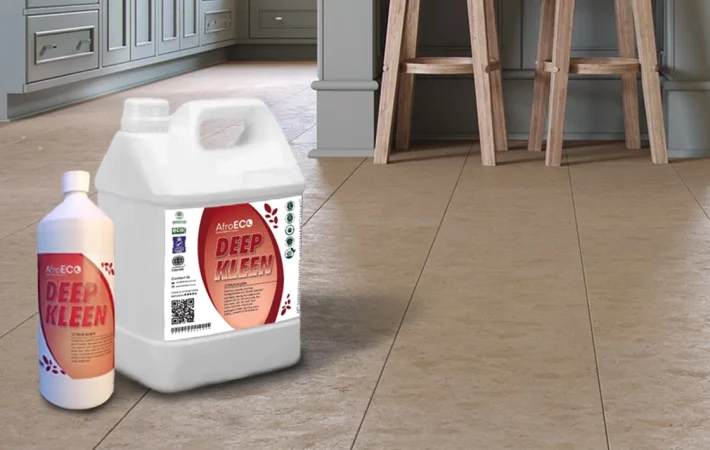
Explore AfroECO’s eco-conscious cleaning range here: Shop the range


Leave a comment
Your email address will not be published. Required fields are marked *