Your restaurant kitchen might look spotless, but what happens beneath your sinks and inside your drainage system could be costing your business money.
Every day, commercial kitchens handle cooking oils, fats, sauces, meat juices, and food waste.
Although much of this waste is removed during cleaning, some fats, oils, and grease (FOG) can enter drainage systems.
Over time, grease buildup can contribute to blocked pipes, unpleasant odours, emergency plumbing work, and interrupted kitchen operations.
This is why effective restaurant grease trap maintenance should be part of every commercial kitchen’s cleaning programme.
Let’s explore the hidden costs of grease buildup and how restaurant owners can prevent avoidable problems.
What Causes Grease Buildup in Commercial Kitchens?
Grease buildup occurs when fats, oils, and other residues enter kitchen drainage systems.
Common sources include:
- Cooking oil and food preparation waste.
- Fat residue from pots, pans, and utensils.
- Meat juices and oily sauces.
- Grease washed from preparation surfaces.
- Food particles entering floor drains and sinks.
When grease cools, some of it can solidify or stick to pipe surfaces.
As more material collects, it can trap food particles and reduce the space available for wastewater to flow.
Grease traps are designed to separate much of this material from wastewater before it reaches the sewer system.
However, they require regular inspection, cleaning, and proper maintenance.
5 Hidden Costs of Poor Grease Trap Maintenance
1. Expensive Emergency Plumbing Repairs
A blocked kitchen drain can quickly become an operational emergency.
When wastewater cannot flow properly, sinks may back up and staff may be unable to continue normal cleaning or food preparation activities.
The business might then need urgent plumbing assistance, drain clearing, or grease trap servicing.
Emergency work can cost considerably more than planned maintenance.
The smarter approach: Monitor drainage performance and schedule routine inspections before serious blockages develop.
2. Unpleasant Odours That Affect the Customer Experience
Grease traps can produce unpleasant smells when organic waste accumulates and begins breaking down.
If these odours spread into food preparation areas, passages, or dining spaces, they can affect the customer experience.
An unpleasant smell may also raise concerns about kitchen hygiene, even when the visible areas are clean.
The smarter approach: Combine proper waste disposal, regular trap cleaning, and appropriate odour-management procedures.
3. Interruptions to Kitchen Operations
In a busy restaurant, downtime can be expensive.
A drainage problem may interrupt dishwashing, cleaning, or food preparation.
Staff may need to stop their normal duties while the problem is investigated.
In serious cases, parts of the kitchen might become temporarily unusable.
The smarter approach: Include drains, sink strainers, and grease traps in the kitchen’s preventive maintenance schedule.
4. Additional Cleaning and Labour Costs
Grease accumulation can make kitchen cleaning more demanding.
Staff may spend additional time cleaning greasy surfaces, addressing recurring drain smells, or managing wastewater problems.
Repeated cleaning without addressing the underlying cause can also increase product consumption.
The smarter approach: Use appropriate cleaning products for each task and ensure grease is collected before it enters drainage systems.
5. Wastewater and Compliance Problems
Restaurants and other food-service businesses may be required to manage fats, oils, and grease according to local municipal rules and wastewater discharge requirements.
Poor grease management can contribute to sewer blockages and environmental contamination.
Failure to meet applicable requirements may lead to enforcement action or additional costs.
The smarter approach: Understand the requirements of your local municipality and maintain records of grease trap inspections, cleaning, and waste disposal.
Why Restaurant Grease Trap Maintenance Matters
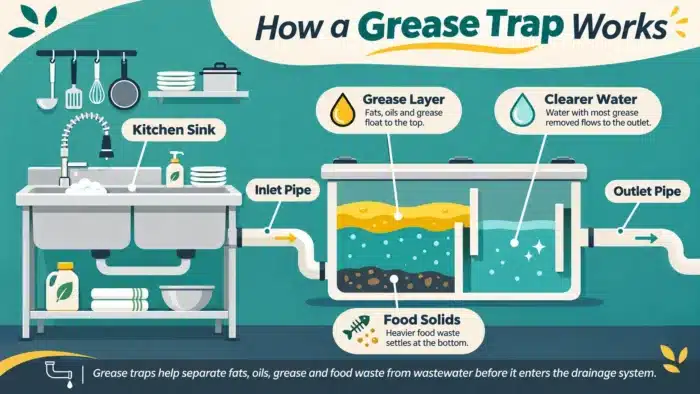
A grease trap is designed to slow wastewater flow so that grease can separate from the water.
FOG typically floats toward the top, while heavier food solids settle toward the bottom.
The remaining wastewater passes through the system.
However, grease traps have a limited holding capacity.
Once too much grease and solid waste accumulate, the equipment becomes less effective.
This can allow material to escape into downstream pipes or cause wastewater to back up.
Regular servicing is therefore essential, regardless of which cleaning or biological treatment products a kitchen uses.
How to Reduce Grease Buildup in Your Restaurant Kitchen
Step 1: Keep Cooking Oil Out of the Drain
Never use the kitchen sink as a disposal point for leftover cooking oil.
Instead, collect used oil in appropriate containers and arrange collection or disposal through a suitable waste service.
This reduces the amount of grease entering the wastewater system.
Step 2: Scrape Plates and Pans Before Washing
Food scraps and greasy residue should be removed before dishes enter the washing area.
Encourage kitchen staff to scrape plates and wipe heavily greased cookware before washing.
Install sink strainers to catch food particles.
These simple habits can reduce the load placed on grease traps.
Step 3: Use an Appropriate Kitchen Degreaser
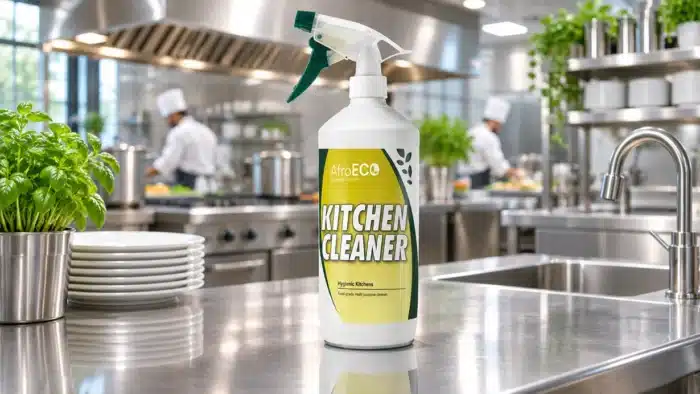
Grease buildup doesn’t only affect drainage systems.
It also collects on stovetops, extraction hoods, tiles, work surfaces, and equipment exteriors.
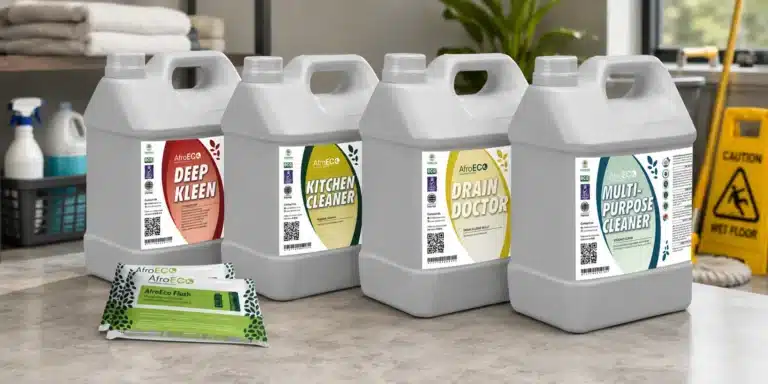
AfroECO Kitchen Cleaner is formulated for cleaning food preparation areas and tackling grease and grime.
For more demanding applications, the AfroECO Degreaser range offers formulations designed for different types of grease, oil, and industrial residue.
Always select the appropriate formulation and follow its instructions, particularly on food-contact surfaces.
Remember that surface degreasing and grease trap treatment are different maintenance tasks.
Step 4: Introduce Biological Grease Trap Maintenance
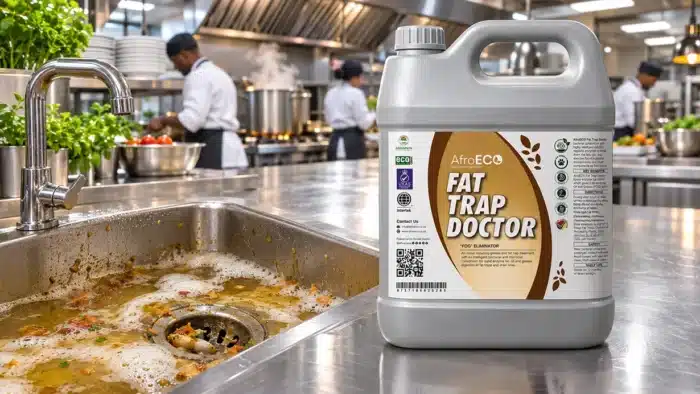
Biological fat trap treatments can support routine maintenance by helping break down certain organic materials.
AfroECO Fat Trap Doctor is designed for commercial grease traps and drainage systems.
Its biological formulation uses bacteria and enzymes intended to help digest fats, oils, grease, proteins, and starches.
With appropriate use, this treatment can support odour management and help reduce organic buildup.
The product is marketed for several commercial environments, including:
- Restaurants and takeaway kitchens.
- Hotels, lodges, and guesthouses.
- School and workplace canteens.
- Butcheries and food processing facilities.
- Shared and communal grease traps.
Important: Biological treatment supports maintenance. It does not replace scheduled grease trap emptying, inspection, or mechanical cleaning.
Step 5: Maintain a Cleaning and Inspection Schedule
Every restaurant should have a documented cleaning programme.
Your schedule might include:
| Frequency | Recommended action |
|---|---|
| Daily | Remove food waste and clean sink strainers |
| Daily | Clean food preparation surfaces and greasy equipment |
| Daily | Check for slow drainage, smells, or visible leaks |
| Weekly | Review grease management procedures and maintenance records |
| As required | Inspect and empty grease traps according to usage and applicable requirements |
| Regularly | Apply suitable biological maintenance treatment according to product instructions |
The appropriate grease trap service frequency depends on the size of the trap, kitchen activity, waste volume, and municipal requirements.
Can Bio-Enzyme Products Help Reduce Commercial Kitchen Maintenance Costs?
Biological cleaning technologies are increasingly considered as part of preventive cleaning and wastewater maintenance programmes.
Enzymes can help break down certain organic materials into smaller components.
Specialised microbial formulations may also support the degradation of organic waste under suitable conditions.
For commercial kitchens, these processes can complement good cleaning practices and mechanical grease trap servicing.
Potential operational benefits include better odour management and reduced organic residue accumulation.
However, results depend on the formulation, dosage, wastewater conditions, trap design, and maintenance practices.
A biological product should never be used as an excuse to stop inspecting or emptying a grease trap.
Frequently Asked Questions
How often should a restaurant grease trap be cleaned?
There is no single cleaning interval suitable for every restaurant.
The frequency depends on the size of the trap, food preparation activities, grease accumulation, and local requirements.
Inspect the trap regularly and arrange servicing before it becomes overloaded.
What causes bad smells from restaurant grease traps?
Common causes include decomposing food waste, accumulated fats and grease, poor maintenance, and drainage problems.
Persistent odours should be investigated rather than simply covered with fragrance.
Can I pour boiling water into a grease trap to remove grease?
Boiling water is not a reliable grease management method.
It may temporarily soften grease and move it further into the drainage system, where it can cool and accumulate again.
What is a bio-enzyme grease trap treatment?
It is a product that uses enzymes, microorganisms, or both to help break down suitable organic waste.
These products may support routine maintenance when used according to their instructions.
Is AfroECO Fat Trap Doctor suitable for commercial kitchens?
Yes. AfroECO markets Fat Trap Doctor for grease traps and drainage systems in restaurants, hotels, lodges, canteens, butcheries, and food processing facilities.
The recommended treatment depends on the trap size and product concentration.
Protect Your Kitchen, Your Customers and Your Business
Grease management is more than a cleaning task. It’s part of responsible commercial kitchen operations.
By controlling cooking oil waste, maintaining grease traps, using appropriate cleaning products, and addressing drainage problems early, businesses can reduce avoidable maintenance risks.
AfroECO offers products designed to support different parts of this cleaning and maintenance process.
Explore AfroECO’s commercial kitchen solutions:
- AfroECO Fat Trap Doctor – Biological grease trap treatment for commercial wastewater systems.
- AfroECO Kitchen Cleaner – Cleaning support for food preparation areas and greasy surfaces.
- AfroECO Degreaser – Degreasing solutions for demanding surface-cleaning applications.
Need help selecting a grease management solution for your commercial kitchen?
Contact AfroECO for product information and guidance on suitable applications.
Cleaner kitchens. Better maintenance. Responsible sanitation.