
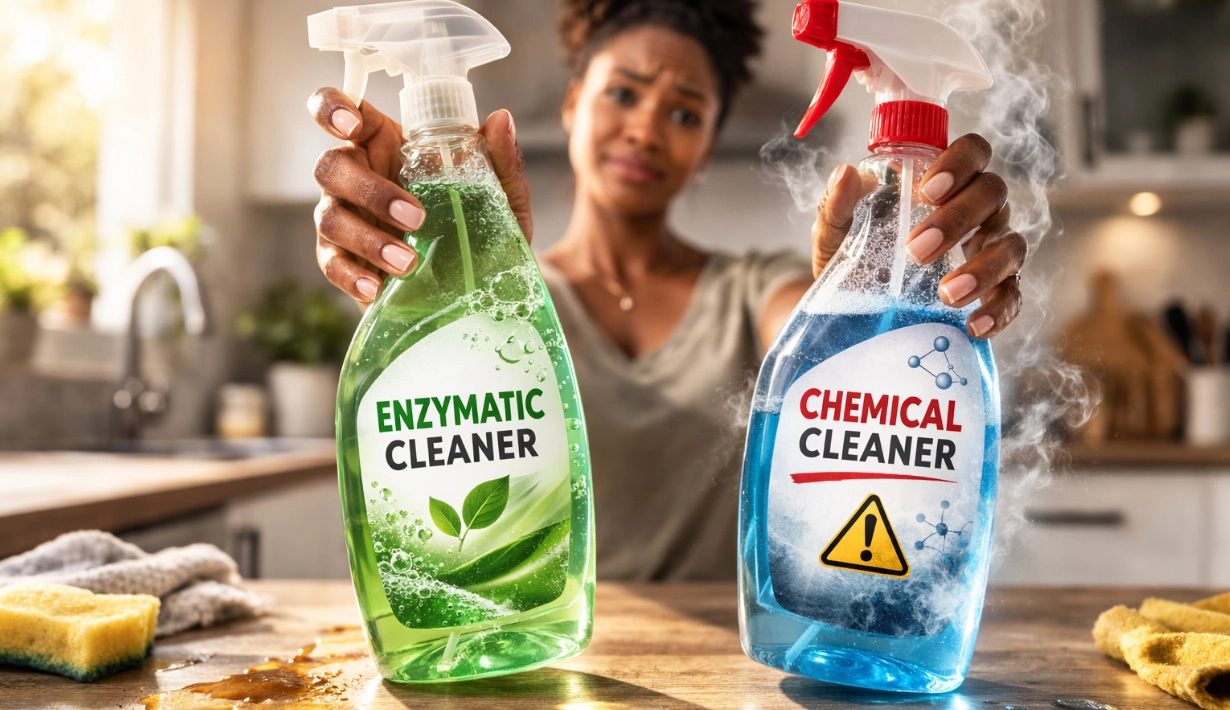
If you’ve ever stood in a shop aisle staring at labels and wondering what’s actually better, you’re not alone. The debate around enzyme cleaner vs chemical cleaner usually comes down to three things: results, safety, and long-term impact. And the truth is—both can “clean”, but they don’t work the same way at all.
In this guide, we’ll break down the real differences between an enzyme cleaner vs chemical cleaner, explain when each one makes sense, and help you choose the best option for your home (especially if you care about health, pets, kids, and the environment).
What’s the Difference Between an Enzyme Cleaner vs Chemical Cleaner?
The easiest way to understand enzyme cleaner vs chemical cleaner is to look at how each one removes dirt.
Enzyme cleaners
Enzyme cleaners use natural enzymes (and often beneficial bacteria) to break down organic mess—things like:
- Grease and food residue
- Sweat and body oils
- Urine and other bathroom odours
- Organic stains
- Drain buildup caused by gunk
Instead of “burning” grime off surfaces, an enzyme cleaner works by digesting the mess and reducing the source of odours.
Chemical cleaners
Chemical cleaners usually work by using stronger chemical reactions to:
- Dissolve grease fast
- Bleach or disinfect surfaces
- Strip stains
- Kill germs quickly
They can be effective, but many are also harsh—especially when used often, mixed incorrectly, or used in small, poorly ventilated spaces.
How Enzyme Cleaners Work (In Plain English)
An enzyme cleaner is like sending tiny “workers” to eat the mess. Each enzyme targets specific organic material. That’s why enzyme cleaners are excellent for:
- Kitchens (oils, food spills)
- Bathrooms (odours, residue)
- Laundry (sweat, stains)
- Drains (organic buildup)
A big advantage in the enzyme cleaner vs chemical cleaner debate is that enzyme cleaning can keep working after you apply it—especially on odours and buildup—because it’s breaking down the source, not just masking it.
How Chemical Cleaners Work (And Why They Feel “Stronger”)
Chemical cleaners often feel more powerful because they can act fast and give that instant “sterile” smell. Some also disinfect aggressively.
But in the enzyme cleaner vs chemical cleaner comparison, “stronger” doesn’t always mean “better” for daily use. Strong chemical cleaners may:
- Irritate skin or trigger allergies
- Leave harsh residues
- Damage sensitive surfaces over time
- Create toxic fumes (especially in bathrooms)
And very importantly: some chemical cleaners are dangerous when mixed (like bleach + ammonia-type products). It’s one reason many homes are moving toward safer routine cleaning options.
Enzyme Cleaner vs Chemical Cleaner: Which Cleans Better?
This is the question everyone asks — so here’s the honest answer:
Enzyme cleaners clean better when the mess is organic
Enzyme cleaning shines for:
- Odours that keep coming back
- Grease buildup
- Stains from sweat, food, pet mess
- Drains that smell or run slowly due to organic gunk
In the enzyme cleaner vs chemical cleaner debate, enzymes win on odour source removal.
Chemical cleaners clean better for instant disinfection needs
Chemical cleaners may be the better choice for:
- Specific disinfecting moments (e.g., illness in the home)
- Certain mould situations (depending on the product and surface)
- Heavy-duty industrial mess (where safety gear is used properly)
So if you’re comparing enzyme cleaner vs chemical cleaner, the “best” choice depends on what you’re trying to solve.
When to Use an Enzyme Cleaner (Best Everyday Choice)
Use an enzyme cleaner when you want:
- A safer daily routine
- Less harsh smell in the house
- Effective cleaning without strong fumes
- Something that’s gentler on surfaces and hands
Common use cases:
- Kitchen counters and stove areas
- Bathroom surfaces and odour-prone areas
- Laundry smells and stains
- Drains and pipes (organic buildup)
If your home has kids, pets, or anyone sensitive to strong smells, an enzyme cleaner vs chemical cleaner comparison often leans strongly toward enzyme-based products for day-to-day cleaning.
When to Use a Chemical Cleaner (Occasional Use)
Chemical cleaners aren’t automatically “bad”—but they’re best used intentionally.
Use a chemical cleaner when:
- You need rapid disinfection
- You’re treating a specific problem that enzymes aren’t designed for
- You’re following proper ventilation and label instructions
If you do use chemical cleaners, a good approach is: chemical for occasional disinfecting, enzyme for regular cleaning. That balance gives you results without turning your home into a chemical zone.
Health & Safety: Enzyme Cleaner vs Chemical Cleaner
This is where many households decide quickly.
Enzyme cleaners are typically easier to live with
Many enzyme-based cleaners are designed to be:
- Lower-irritation
- Less fume-heavy
- Safer for frequent use
Chemical cleaners require more caution
Some chemical cleaners can:
- Irritate eyes and skin
- Worsen asthma triggers
- Create harmful fumes in enclosed spaces
So in the enzyme cleaner vs chemical cleaner decision, think beyond “does it clean?” and ask: what does it leave behind, and what does my family breathe in?
Environmental Impact: Enzyme Cleaner vs Chemical Cleaner
Enzyme cleaners often align better with eco-friendly goals because they work with biodegradable processes and reduce harsh chemical runoff. Chemical cleaners can contribute to heavier chemical loads entering water systems.
If your cleaning routine is frequent (which it usually is), the enzyme cleaner vs chemical cleaner debate becomes a lifestyle decision—small changes daily add up over time.
Quick Cheat Sheet: Which One Should You Choose?
If you want everyday cleaning, go enzyme.
If you want occasional disinfection, use chemical carefully.
Choose an enzyme cleaner if you’re cleaning:
- Grease, food mess, bad smells
- Laundry odours
- Pet mess / organic stains
- Drains with organic buildup
Choose a chemical cleaner if you need:
- Quick disinfecting for specific situations
- Targeted heavy-duty treatment (with ventilation)
That’s the simplest way to settle the enzyme cleaner vs chemical cleaner question.
FAQs: Enzyme Cleaner vs Chemical Cleaner
Is an enzyme cleaner a disinfectant?
Not always. Many enzyme cleaners focus on breaking down organic waste and reducing odours. If you need disinfection, use a product specifically labelled as a disinfectant.
Can I use enzyme cleaner every day?
Yes — that’s one of the big benefits in the enzyme cleaner vs chemical cleaner comparison. Enzyme cleaners are often designed for regular use.
Can I mix enzyme cleaner with bleach?
No. Don’t mix products. Bleach can kill the enzymes and may create harmful fumes depending on what it reacts with. Use one product at a time, and rinse properly if switching.
Why do enzyme cleaners help with bad smells?
Because enzyme cleaning breaks down the source of the smell (organic residue), instead of masking it with perfume.
Final Thoughts: Enzyme Cleaner vs Chemical Cleaner
When you compare enzyme cleaner vs chemical cleaner, the best answer is usually:- Enzyme for everyday cleaning, odours, and organic mess
- Chemical for occasional disinfection or special cases


Leave a comment
Your email address will not be published. Required fields are marked *